Are some SSL Certificate providers more equal than others?
Earlier this year Ionos (previously 1&1 in the UK) announced that they were changing their partner from Digicert to Sectigo issuing certificates to secure your website.
“Certificates are the backbone of secure online interactions, particularly for SMEs navigating today’s digital-first economy,” said Achim Weiss, CEO of IONOS. “Sectigo’s unmatched technical excellence and reliability align perfectly with our mission to empower businesses with superior digital security solutions. Together, we’re strengthening our customers’ ability to thrive in an increasingly connected world.”
https://www.ionos.co.uk/newsroom/news/ionos-partners-with-sectigo-to-redefine-digital-security-for-over-6-million-customers
Background
Ionos' previous partner DigiCert is jointly owned by private equity firms Clearlake Capital Group and TA Associates. These two firms became equal partners in DigiCert in 2019 after making a strategic investment in the company.
According to Ionos website, Sectigo was formerly known as Comodo CA (Certification Authority). However, in October 2017, another private equity company, Francisco Partners acquired Comodo Certification Authority (Comodo CA) from Comodo Security Solutions, Inc. Francisco Partners rebranded Comodo CA in November 2018 to Sectigo.
Installation
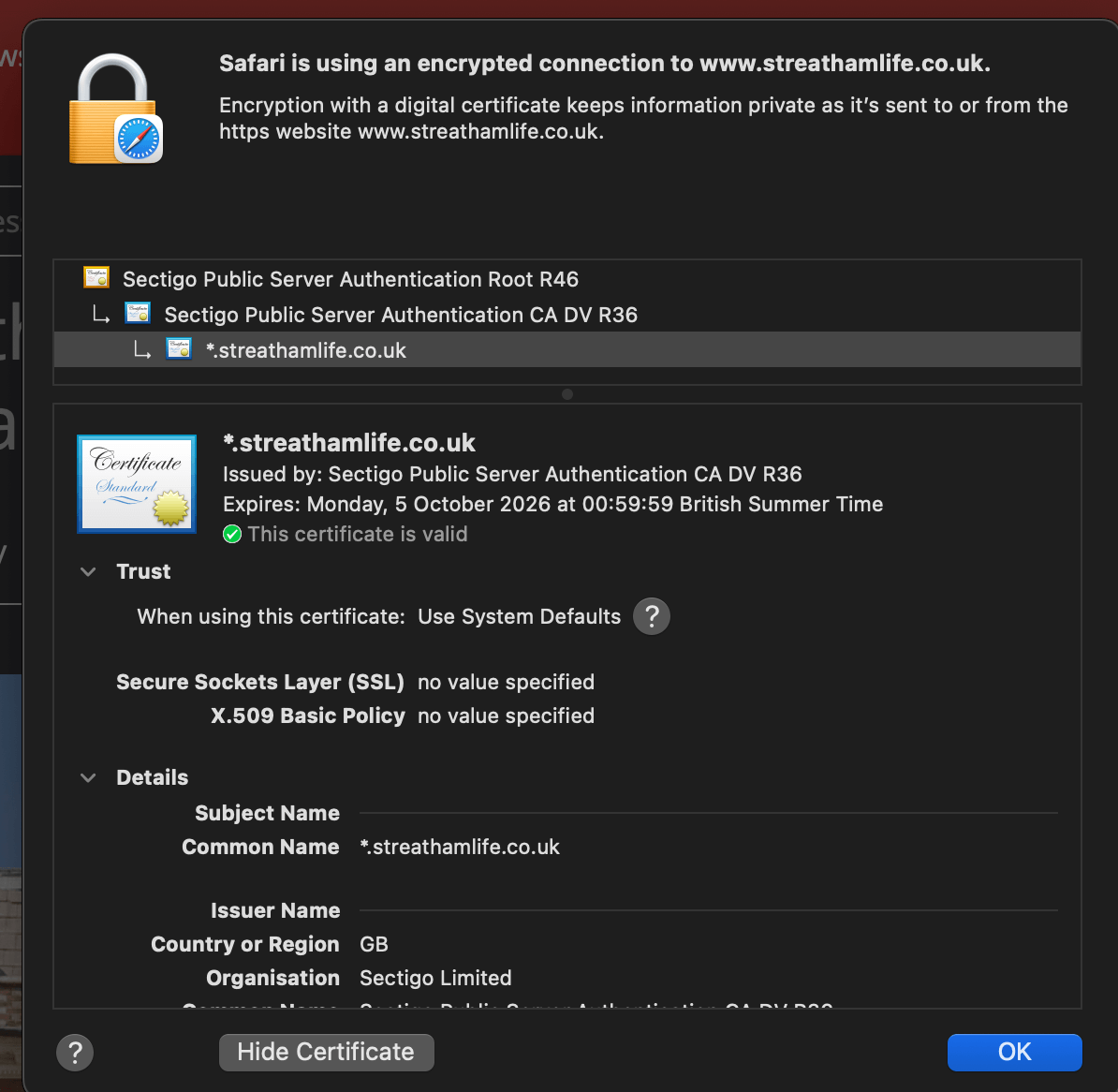
SSL certificates are usually renewed every year. I have recently switched a couple of my domains to the new certificate being offered by Ionos. In spite of some issues with Ionos' allocation of certificates based on contracts rather than domains, I eventually managed the switch over to the new Sectigo certificates fairly seamlessly.
Here is a screenshot showing the newly installed "valid" certificate.
Issues
At the time I was able to validate the new certificate in my web browser and everything seemed to be working as before. However over a few weeks I did notice some erratic behaviour with the website. This included:
- Website monitoring appeared broken (360 monitoring)
- Posts on X inconsistently displaying any meta data or not unfurling to display twitter meta data
- Posts on Slack not unfurling and displaying correct meta data
- Fonts not loading when creating pdf's of webpages
I was experiencing the same behaviour for at least 2 sites, both of which had their SSL certificates recently renewed. A third site, that was also renewed, used a more robust LetsEncrypt certificate (for web traffic (more robust at handling traffic forwarded from another top level domain) seemed unaffected.
Investigation
My first thought was there was an issue with the metadata. I spent some time reviewing the use of the Drupal's Metatag module and even made some small progress on a previously reported bug. However I could not really see any change here that could have caused the unfurling to just stop working.
My breakthrough came when I decided to validate my HTML to see if there were any issue with the markup that could be causing an issue using the W3C HTML validator. Rather than copy and pasting the markup from your site there is now an option to point it at your site or web page. I received the error:
"Certificate Verify Failed"
Here is one screenshot:
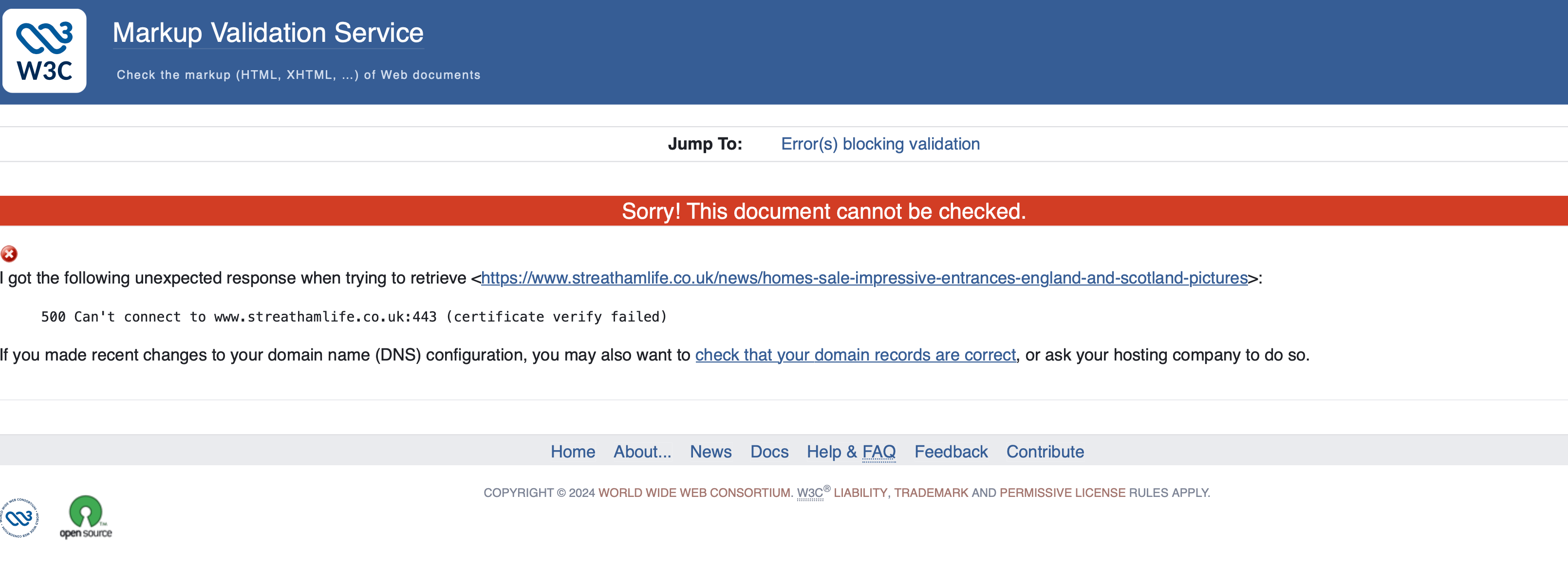
Bingo. In hind sight I probably should have realised that there was a problem with the new certificate. When inspecting via a web browser or even a curl request, the certificate seemed fine, but when calling via various api's, (w3c validator, 360 monitoring, X and Slack), it appeared the new SSL certificate could be verified and a 500 server error is shown.
I contacted Ionos to see if anyone else was experiencing similar issues. I explained the issues I was having but they denied there was any issue with the certificate and suggested the issue with unfurling was probably caused by my website not having the correct meta data! It's mad that I am paying them for this advice!
Workaround
I was simply able to quickly install a LetsEncrypt certificate rather than the supplied Sectigo certificate in order to enable various API's to be able to access my site on a consistent basis. At which point all the affected apis previously mentioned were able to reach my site(s).
Solution
A year later us is time to renew the certificates and decided to look into this again. In previous years I had simply copied the intermediate or Certificate Authority certificate or chain across from previous years. Of course changing from Digicert is linked ti a different authority and requires a new intermediate certificate that links to the Authorities root certificate. If not in place the certificate will not be trusted by various api's, Navigating a site with a web browser is actually more forgiving as they typically support Authority Information Access (AIA) fetching, an extension in X.509 certificates that allows a client to dynamically download missing intermediate certificates during a TLS handshake.
Loading metadata but be unable to load or preview the image
This specific breakdown happens because X (Twitter) utilizes two completely separate mechanisms—and sometimes entirely different servers—to scrape the textual metadata vs. downloading the preview image.
When your server lacks the intermediate certificate, the automated systems behind X experience a partial handshake failure.
Why Text Shows, but the Image Fails
- The HTML Scraper Passes (Text): When you paste a link, X's primary page crawler (
Twitterbot) hits your main URL. If your HTML page is served over a standard CDN, a reverse proxy with cached certificates, or if the bot tolerates a broken chain on the initial request, it successfully reads the<meta name="twitter:title">and description tags. - The Media Fetcher Fails (Image): To display the actual image, X extracts the image URL from your
<meta name="twitter:image">tag. A separate, strict media-caching service handles downloading that asset. This media bot connects directly to your image hosting domain and operates like an explicit API client. Because it does not support AIA Fetching or intermediate certificate caching, the SSL handshake crashes immediately when it encounters the missing link. It aborts the connection, leaving you with text-only metadata
Many web scrapers are written in languages like Go, Node.js, or Python. By default, these languages fail strict TLS checks if an intermediate is missing. However, because a scraping bot’s primary mission is to gather textual metadata from as many websites as possible, engineers often configure the initial HTTP client with strict SSL validation disabled.
Summary
After switching from a valid Digicert to Sectigo Certificate, it appears to me that the 2 are not equal remember to download and install a new intermediate (Certificate Authority) certificate! Although your certificate may appear correct in the web browser, it will likely fail most strict TLS checks if an intermediate is missing. That is many API's will fail with validating the new certificate that can make your site unreachable. This is not immediately obvious. In my example the control panel or server gave no clue that the intermediate cert was not valid. as it can also be erratic. e.g. Sometimes it seem to be able to connect and not on other times. While it is a that something has gone awry with the set up and installation of these valid certificates, it also possible that they simply do no work as intended for a number of high profile API's.
Add new comment